Brazil has long been recognized as having one of the most complex tax environments in the world—particularly in the area of indirect taxation. With the recent approval of the Tax Reform, the country is entering a historic transition that will reshape how taxes are structured, calculated, and reported.
While the Reform’s primary objective is to simplify and modernize Brazil’s tax system, the legislation introduces a new framework that, in some cases, may still reflect the complexities that businesses—especially those using SAP—have struggled with for decades. For companies running SAP in Brazil, adapting to these changes will require a careful review and redesign of their tax configuration and reporting processes.
The Tax Reform aims to unify and streamline consumption taxes by replacing four existing taxes—PIS, COFINS, ICMS, and ISS—with two new taxes:
- CBS (Contribution on Goods and Services): Managed by the federal government.
- IBS (Tax on Goods and Services): Managed jointly by states and municipalities.
| Pain points in the current system | Pillars of the Tax Reform |
|---|---|
| Five Taxes, Multiple Rules The current framework is composed of five main taxes (ICMS, ISS, IPI, PIS, and COFINS), each governed by distinct rules, rates, and compliance requirements. Businesses must navigate: Federal, state, and municipal jurisdictions, Constantly changing legislation, Complex combinations of tax applicability by product, region, and transaction type. | Fewer Taxes, Unified Rules The new system will replace multiple indirect taxes (ICMS, ISS, IPI, PIS, and COFINS) with two broad-based VATs: CBS (Contribuição sobre Bens e Serviços) at the federal level, IBS (Imposto sobre Bens e Serviços) at the state and municipal levels. Instead of a patchwork of conflicting laws, there will be a single national legislation governing these taxes, with federal entities allowed only to define general rates. This change reduces regional variations and legal uncertainty, streamlining tax configuration in SAP systems. |
| Complex Tax Calculation Scenarios Tax calculation methods vary drastically across processes and tax types. Companies must handle scenarios such as: Cumulative vs. Non-cumulative PIS/COFINS, ICMS-ST (Substituição Tributária) and its chain effects, “Gross-up” methodologies where taxes are part of the base for other taxes, DIFAL (ICMS for interstate operations to end-consumers), And the requirement to pay taxes at the point of origin, further complicating logistics and pricing models. | Simplified Taxation at Destination A major change in the reform is the shift to destination-based taxation: Taxes will be calculated on the value-added to the transaction (“outside the price”), The tax is collected where the goods or services are consumed, not where they originate. This simplifies tax determination logic in SAP and removes the complexity of current interstate and intrastate tax rules (e.g., ICMS and DIFAL). |
| Tax Credit Restrictions and Residual Balances Legal constraints on credit utilization and the coexistence of multiple tax regimes result in: Inability to fully recover input tax credits, High levels of unrecoverable tax (custo Brasil), Manual tracking of eligible vs. non-eligible credits. | Full Non-Cumulativity Under the new regime: Input tax credits will be fully allowed across the chain, without exceptions (except for personal-use items), Businesses will no longer face limitations or disallowances on eligible credits. |
| Proliferation of Tax Benefits and Incentives Numerous tax incentives—varying by industry, region, and government level—create a “tax war” among Brazilian states. These benefits: Are inconsistently applied or interpreted, Require constant legal analysis and configuration updates in SAP, Impact business competitiveness and profitability. | Targeted Exceptions and Cashback Mechanisms While the system aims for uniformity, there will be: Limited exceptions for specific essential goods and services (as defined in Brazil’s Federal Constitution), Cashback mechanisms to support low-income consumers by refunding a portion of the tax. These features aim to balance tax fairness with social inclusion, while minimizing complexity for SAP configuration through predefined exception handling. |
| Accumulation of Credits and Bureaucratic Reimbursement The system often results in large accumulated tax credit balances, particularly for exporters and capital-intensive industries. However: The process to recover or offset these credits is highly bureaucratic, There are strict deadlines and documentation requirements, Reimbursement often takes years or is not feasible at all. | Centralized Tax Administration and Guaranteed Reimbursement The administration of the new tax system will be handled by a Central Administrative Committee: This committee will oversee IBS collection and distribution across federal entities, It will operate independently from state or municipal treasuries, Tax credit reimbursements will be guaranteed and streamlined, reducing the current bureaucracy and delays faced by businesses. This model improves taxpayer security and greatly enhances the efficiency of credit refund processes — a significant benefit for SAP-managed financial and tax operations. |
Tax Reform Transition Period in Brazil: What to Expect Between 2025 and 2033
Given its complexity, the transition to the new system won’t be immediate — it will unfold gradually over seven years, starting in 2025. The reform is structured into three key phases, each with distinct milestones and implementation challenges that businesses must prepare for.

Click the image to see it larger.
Phase 1 – The Test Year: 2026
Although the reform is already under regulatory discussion in 2025, the practical transition begins in 2026, a year designated as a “testing period” — but only for the government. For companies, it’s not optional: your systems must be ready for production by January 2026.
During this test year, the CBS (Contribution on Goods and Services) and the IBS (Tax on Goods and Services) will start appearing on fiscal documents with a symbolic combined rate of 1% (0.9% for CBS and 0.1% for IBS). These fields are already integrated into the updated NF-e layout, requiring businesses to properly configure systems to support dual tax environments.
The goal is not to impact tax burden during this phase. The amounts paid can be credited against existing PIS, COFINS, ICMS, and ISS liabilities — ensuring fiscal neutrality. However, companies with large PIS/COFINS or ICMS credits may face cash flow pressure, since these new taxes must be collected even if they can’t yet be offset.
Note: Under certain conditions, the 1% may be waived if auxiliary obligations are correctly fulfilled — an item still under regulatory refinement in 2025.
Phase 2 – CBS Becomes Official: 2027
Starting January 2027, PIS and COFINS will be eliminated, and the CBS will take full effect. The IPI (Tax on Industrialized Products) will be reduced to zero, except for products manufactured in the Free Trade Zone (ZFM), which will retain IPI under current rates.
This year also marks the introduction of the Selective Tax (IS) — aimed at discouraging the consumption of harmful goods (e.g., tobacco, alcohol, sugary drinks).
Companies will begin to feel the true operational and financial impact of the reform, particularly those who previously relied on tax incentives or special regimes that won’t carry over under the new legislation.
From a systems perspective, 2027 is particularly challenging: businesses must operate dual tax calculation engines — one for the old regime and one for the new — requiring careful process segregation and configuration.
Phase 3 – ICMS and ISS Phase-Out: 2029 to 2032
The transition of state and municipal taxes (ICMS and ISS) begins in 2029, with rates decreasing by 10% per year. At the same time, IBS will be gradually increased to replace them.
By 2033, the switchover will be complete. All operations will be fully taxed under the new IVA-style model, and the legacy tax system will be fully retired. This will finally simplify Brazil’s complex, multi-jurisdictional tax framework — but only after years of preparation, dual operations, and system adjustments.
2025 – The Year of Preparation
Although 2026 is the start of official implementation, 2025 is the year of planning and readiness. Companies must:
- Update systems for the new NF-e layout with CBS/IBS fields
- Train tax and IT teams on the dual tax model
- Evaluate cash flow impacts of credit recognition timing (tax credits will only be valid upon actual tax payment)
- Simulate operations with test environments starting in September/October 2025
- Define internal governance, separating responsibilities for old and new tax operations
Key Takeaways
- The test phase is mandatory for companies, not optional.
- The 1% rate in 2026 is not an added tax burden, but system readiness is essential.
- Dual tax environments (old and new) will coexist from 2026 to 2032.
- The complete transition will take seven years, concluding in 2033.
- Companies must start adapting now to avoid risks of non-compliance, NF-e rejection, or financial disruptions.
The Business Impact of Brazil’s Tax Reform
Brazil’s Tax Reform represents a massive shift in the country’s indirect tax system, and its effects go far beyond the tax team. To succeed during this transition, companies must assess how the Reform will reshape every area of their operations — not just in 2026, but across the entire transition period until 2033.
It will require your company to reassess its entire SAP landscape, business structure, finance operations, and strategic positioning in Brazil.
Tax Reform: What’s Changing, and How It Affects Your Business
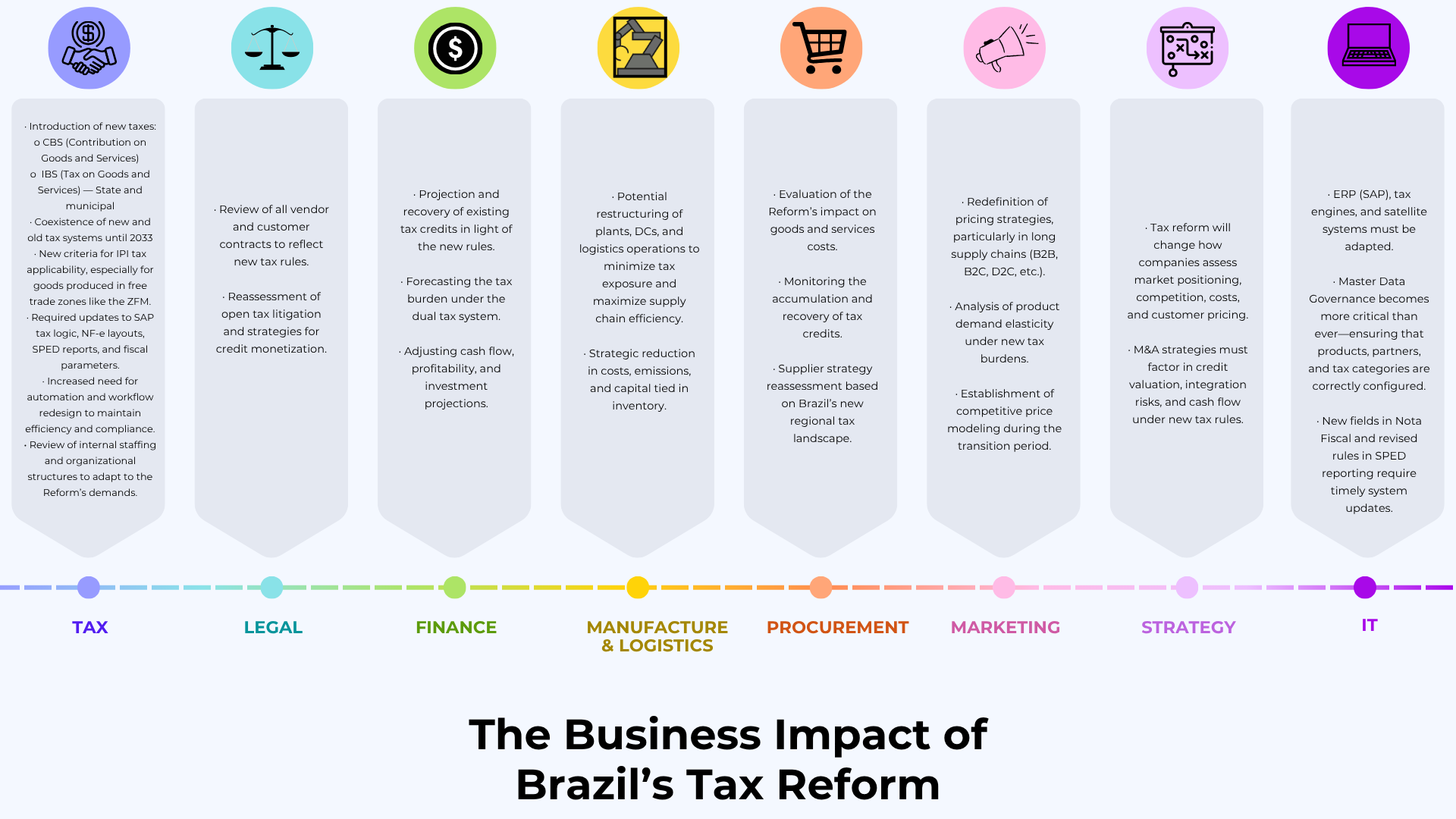
Click the image to see it larger.
Key References and Official Sources for Brazil’s Tax Reform
Legislative Framework
Constitutional Amendment No. 132/2023
Emenda Constitucional nº 132, de 20 de dezembro de 2023
This constitutional amendment establishes the foundation for Brazil’s Tax Reform. It introduces the unification of federal, state, and municipal consumption taxes, leading to the creation of CBS and IBS, and outlines the reform’s transition timeline.
Access the full text (in Portuguese)
Complementary Law No. 214/2025
Lei Complementar nº 214, de 16 de janeiro de 2025
This law provides regulatory detail for the implementation of the CBS (Contribuição sobre Bens e Serviços), outlining the tax rules, credit system, scope, and legal obligations for taxpayers.
📎 Access the full text (in Portuguese)
Electronic Tax Documents (DFe) and Technical Specifications
NF-e and NFC-e Technical Note 2024.002 – Version 1.0
Projeto Reforma Tributária do Consumo – Adequações NF-e / NFC-e
Nota Técnica 2024.002 – Versão 1.0, publicada em 01/08/2024
Outlines the required layout changes in the Nota Fiscal Eletrônica (NF-e) and NFC-e to accommodate the new CBS and IBS tax fields. These changes are crucial for companies issuing invoices in Brazil via SAP.
📎 Available on the National NF-e Portal: https://www.nfe.fazenda.gov.br/
CT-e and NF3-e Technical Note 2024.001 – Version 1.0
Projeto Reforma Tributária do Consumo – Adequação DFe (CT-e / NF3-e)
Nota Técnica 2024.001 – Versão 1.0, publicada em 31/07/2024
Provides technical guidance on updating the layout of CT-e and NF3-e documents to comply with the tax reform’s new data structure and validation rules.
📎 Available on the CT-e Portal: https://www.cte.fazenda.gov.br/
Additional Resources
Receita Federal do Brasil (RFB)
The Brazilian Federal Revenue Service is responsible for issuing regulations and operational guidelines for CBS and coordinating the integration of tax systems during the transition.
📎 https://www.gov.br/receitafederal
Conselho Nacional de Política Fazendária (CONFAZ)
For ICMS and IBS transition coordination, including protocols, conventions, and notes relevant to the states.
📎 https://www.confaz.fazenda.gov.br
Ministério da Fazenda (Ministry of Finance)
Provides policy updates and fiscal impact analyses related to the Reform.
📎 https://www.gov.br/fazenda
Disclaimer: The information above is valid as of the date of publication. Given the dynamic nature of regulatory updates in Brazil, we recommend monitoring official channels and consulting with qualified advisors to stay current.
Copyright Notice: © Leo Anderson and SAPBR.COM (SAP Brazil) WordPress Blog, 2025.
Reproduction or use of this material without the express written permission of the blog’s author and/or owner is strictly prohibited. You are welcome to share brief excerpts or link to content, provided that full credit is given to Leo Anderson and SAPBR.COM, along with a clear and direct link to the original post.
 SAP Blog, SAP BRAZIL, ECC, S/4HANA and more...